SEED
I was born at home in Ealing, London in 1966. A good year for English football, although I arrived a few weeks after we won the World Cup.
By chance, my birthday fell in the week between the First Doctor’s final appearance and the Second Doctor’s debut episode in the BBC series Doctor Who.
The programme had just discovered how not to die.
Regeneration was born at almost exactly the same time I was.
I am not a major Doctor Who fan. Tom Baker was my favourite, obviously.
I like the Daleks too. I tried to build a full-size one when I was about ten. I assume everyone tries to build a Dalek at some point. Some may even finish.
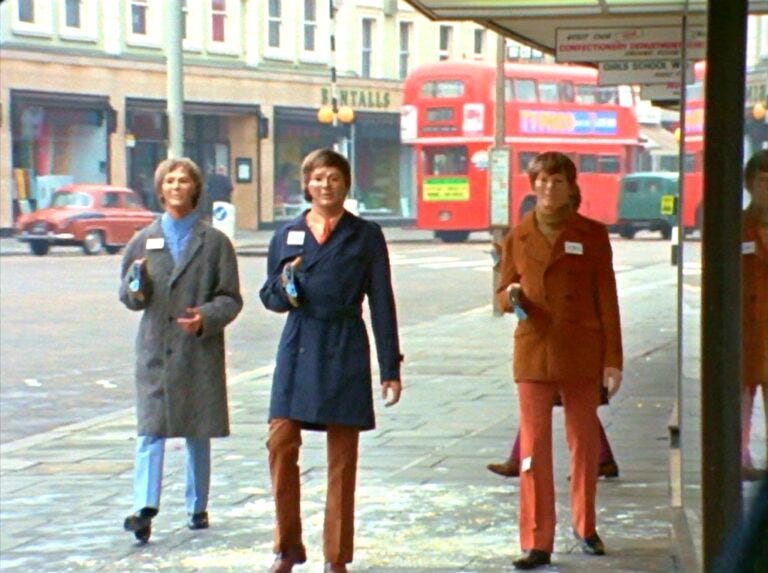
Apart from the Daleks, I have always had a soft spot for the Autons, partly because “Auton” sounds a little like “Outten”. The Autons were plastic shop-window mannequins brought to life by an alien intelligence. They first emerge through the windows of the old John Sanders department store, now long gone, just up the road from Ealing Studios.
The Autons then begin causing havoc in the surrounding streets. At the time, those streets were simply part of Ealing. A few years later, much of the area would disappear beneath the redevelopment that created Ealing Broadway Shopping Centre.
Looking back, that Doctor Who story accidentally preserved fragments of a landscape that no longer exists.
I suspect that is one reason it stayed with me.
Not because of Doctor Who.
Not even because of the monsters.
Because it captured a place before it changed into something else.
CONNECTIONS
A surname.
A monster.
A television programme.
A childhood memory.
A place.
A vanished landscape.
A coincidence.
At first glance these seem like weak connections.
Yet somehow they formed a chain.
Not a logical chain.
A meaningful one.
Most writing seems interested in conclusions.
I find myself increasingly interested in the path.
One thing leads to another.
A place leads to a memory.
A memory leads to a question.
A question leads somewhere unexpected.
That is certainly how this piece emerged.
It began with Doctor Who.
Then became about Ealing.
Then memory.
Then disappearance.
Then something else.
SURVIVAL
There is another twist.
The episodes surrounding that first regeneration do not fully survive.
Like many BBC programmes of the period, parts were wiped and lost.
The sound survives.
Photographs survive.
Scripts survive.
The original recordings largely do not.
The regeneration survived.
The recording did not.
For years, fans have watched animations created from those surviving fragments. More recently, AI has begun to raise the possibility of even richer reconstructions.
Not the original.
Never the original.
But perhaps something closer.
And that is where I became interested.
Not in Doctor Who.
In survival.
In what remains after most of something has disappeared.
RECONSTRUCTION
The Ship of Theseus asks whether a ship remains the same ship after every plank has been replaced.
Trigger’s broom had seventeen new heads and fourteen new handles and was somehow still Trigger’s broom.
Doctor Who changes actors.
Still Doctor Who.
Missing episodes become animations.
Still the same story.
Ealing changes.
Still Ealing.
A childhood memory fades, shifts and rebuilds itself over decades.
Still the same memory.
An AI reconstructs lost footage from sound, photographs and notes.
Still the same programme.
An AI tidies up my text.
Still the same text!
The more I think about it, the more these seem to be versions of the same question.
How much can change before something becomes something else?
ARCHIVES
Perhaps that is why archives matter.
Not because they preserve everything.
They don’t.
Most things vanish.
Archives preserve fragments.
A photograph.
A map.
A recording.
A diary.
A television programme.
The rest has to be reconstructed.
By historians.
By archaeologists.
By memory.
By imagination.
And increasingly, perhaps, by AI.
That Doctor Who story was not trying to preserve Ealing.
It was trying to entertain a Saturday evening audience.
Yet sixty years later it contains details that have outlived some of the places it recorded.
I find that strangely moving.
There is another irony.
The Autons were made of plastic.
In the early 1970s plastic still felt futuristic.
Nobody was talking much about microplastics or environmental persistence.
Today the strange thing is not that the Autons came to life.
It is that the plastic probably outlasted half the things around it.
The streets changed.
The department store vanished.
The videotapes were wiped.
The plastic remains. Somewhere.
OPEN QUESTION
I started writing this because Doctor Who was in the news.
I thought it might become an article about regeneration.
Instead it became an article about survival.
Not life and death.
Something quieter.
What survives?
What changes?
And how much can disappear before the thing that remains becomes something new?
I don't know.
But I suspect it is a better question than the one I started with.
Thanks for reading! Subscribe for free to receive new posts and support my work.