I have always liked plants.
Not enough to know them properly.
Not enough to become one of those people who can look at a leaf and tell you its family history, medicinal properties and preferred soil conditions.
I like them at a distance.
Through books.
Through names.
Through television.
Through the general idea of greenness.
I suspect this is not the same thing as gardening.
I planted some seeds recently.
They grew.
This felt like a diplomatic success.
A tiny agreement between myself and the natural world.
I had buried something small and dry in a tray of compost and, against all probability, life had decided to continue.
Not because of me, obviously.
But not entirely despite me either.
That seemed enough.
I thought of The Herbs.
And Bill and Ben.
And Hector’s House.
Kiki on the ladder.
Peering over the wall.
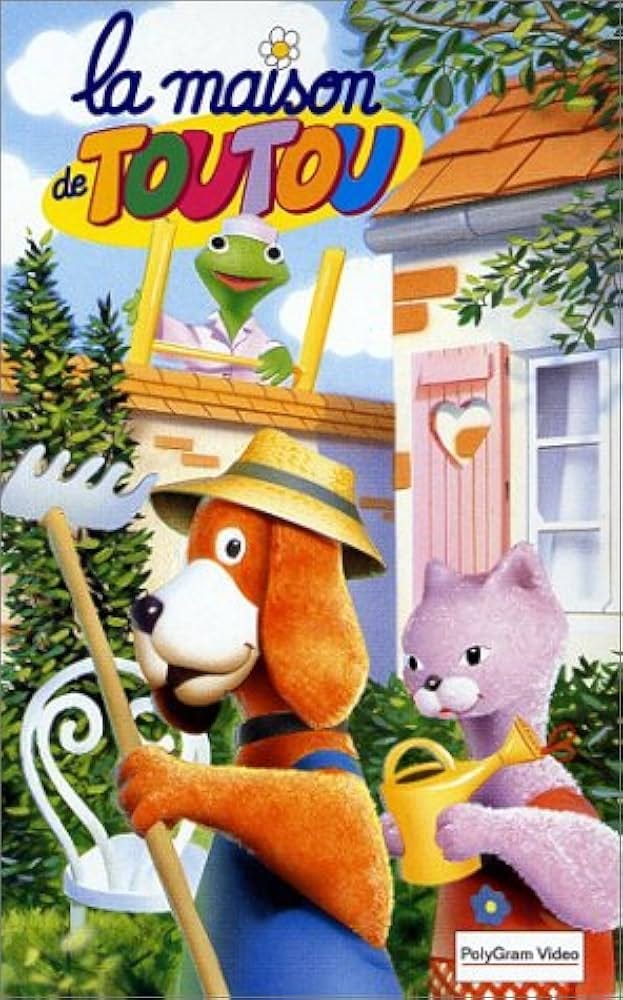
The French Hector’s House arrived six days before I did.
Kiki was already there.
A frog looking over into a walled world.
As were the two flowerpot men.
Shortly after a garden full of herbs
with names and voices.
Early robots, in a way.
Artificial life in a garden.
Puppets with no strings attached.
Not because it is true.
Because it almost is.
Television has always liked to animate the world.
To give a face to a flower.
A voice to a vegetable.
A personality to a patch of earth.
The Herbs did this beautifully.
Parsley.
Sage.
Tarragon.
Dill.
The plants had already solved the problem of becoming interesting by turning into people.
Much easier, really.
I have always found it simpler to love plants once they have drifted slightly away from botany.
Towards character.
Towards symbol.
Towards alphabet.
Towards myth.
Trees
Trees I understand better.
Not botanically.
Emotionally.
Trees are large enough to get away with being mysterious.
They do not seem to mind if you know almost nothing about them.
You can stand beside a tree and contribute very little.
A herb feels more demanding.
It wants proper labels.
A tree is content to be a tree for a thousand years and let you catch up when you can.
I admire that.
I like the old children’s world of herbs because it sits somewhere between gardening and theatre.
Between botany and costume.
Between the greenhouse and the puppet stage.
A soft, manageable world.
Leaves with personalities.
Gardening without the humiliation of slug damage.
And then, somewhere nearby in the same year as The Herbs, there is Richard Brautigan imagining
all watched over by machines of loving grace
which remains one of the loveliest and most suspiciously optimistic phrases ever attached to technology.
A cybernetic meadow.
Mammals and computers living together in mutually programming harmony.
It is impossible not to love that sentence a little.
It is also impossible not to notice that history took a different turn.
Still, I can feel the appeal of it.
Not the Silicon Valley version.
Not optimisation.
Not dashboards and productivity and six apps telling your basil how to feel.
Something smaller than that.
Kinder than that.
A machine that keeps the greenhouse warm.
A sensor that notices the soil has gone dry.
A little system that opens a vent, turns on a light, waters a tray, records a temperature, nudges life along rather than monetising it.
Not artificial intelligence.
Artificial attentiveness.
Or perhaps just assisted care.
That old dream of technology as steward.
Technology in overalls.
Technology with a watering can.
This is where Silent Running drifts in.
Not just the domes.
The robots.
Those little caretaker machines moving around the ship, tending what remains.
Keeping the garden alive in the middle of the void.
And then there is the slightly absurd fact that my first proper job was not entirely unlike this.
It was an ESA project called Biosample.
My job was to build something to detect seeds when they had germinated and move them into a planting area.
Which, looking back on it, sounds less like employment and more like a children’s television version of Silent Running.
A greenhouse in space.
Tiny signs of life being noticed.
Small green things monitored until the moment they were ready to be moved on.
Watched over, in other words.
Not by machines of loving grace, exactly.
But not so very far from them either.
The robots in Silent Running are cousins of Bill and Ben.
Not in appearance.
In function.
Small artificial beings whose job is to keep some version of life going.
A puppet weed.
A robotic gardener.
A flowerpot man.
A droid tending the last forest in space.
Different costumes.
Same dream.
Perhaps I have always liked plants most when they arrive with a layer of artifice attached.
As puppets.
As characters.
As robots.
As symbols.
As television beings.
As though artificial life is sometimes the route by which real life becomes visible.
A puppet with no strings attached.
A robot with a watering can.
A poem about a cybernetic meadow.
A forest carried through space because Earth can no longer be trusted with it.
All of them, in their different ways, are trying to solve the same problem.
How do you care for life?
How do you keep it going?
How do you persuade people to love a plant, a forest, a flowerpot, a tree, a world, enough to look after it?
And perhaps there is a darker version of the same question.
What does it mean to be watched over?
A walled garden is still a walled garden.
The thing that keeps danger out also keeps things in.
The sensor that protects the basil is only a few steps away from the camera pointed at the fence.
Care and surveillance are not identical.
But they are neighbours.
Sometimes very close neighbours.
I once worked on a design project about surveillance equipment for neighbours to spy on their neighbours.
Which now feels oddly relevant.
A camera over the wall.
A watcher in the hedge.
Kiki on the ladder, except with a product spec and a retail box.
The watched garden is not always a safe one.
Sometimes it is just a watched one.
I am not a natural gardener.
I am a reluctant one.
A dabbler in packets.
A sower of occasional seeds.
A man who likes the first act of gardening, and is less committed to the long middle.
Planting is glorious.
Maintenance is where the interview goes wrong.
But perhaps that is why I keep circling back to trees.
Trees operate on a timescale that makes my failings less embarrassing.
They have seen off empires, ideologies, television formats and most of the contents of garden centres.
They are not impressed by my seed tray.
Nor should they be.
And yet I still want some version of the old dream.
Not a machine instead of a garden.
A machine in service to one.
A cybernetic greenhouse.
A watchful windowsill.
A little domestic ecology of sensors, weather, soil, sunlight, memory and care.
Not mastery over nature.
Just cooperation.
A modest alliance between a man who never quite learned his herbs and a few systems that might help him keep something alive.
The wall.
The ladder.
The puppet theatre.
The poem.
The robots.
The seed tray on the windowsill.
All part of the same strange hope.
That technology might still, on its better days, help us notice life rather than escape it.
That the machine might occasionally lead us back to the leaf.
That a packet of seeds, a bit of code, a moisture sensor and a small green shoot pushing up through compost might all belong to the same story.
Not the story we got.
But a good story all the same.
And every now and then, when something germinates, it still feels briefly possible.
A few things over the wall
Richard Brautigan, “All Watched Over by Machines of Loving Grace” (1968)
Silent Running (1972), directed by Douglas Trumbull
The Herbs (1968)
Hector’s House / La Maison de Toutou (1966)
The Flower Pot Men / Bill and Ben (1952)
ESA Biosample / EURECA: A World without Gravity (SP-1251)