Burt Lancaster and I share a birthday.
So does Shah Rukh Khan.
That pleases me.
It creates a small private bridge
between Hollywood and Bollywood.
Between one swimmer
in suburban Connecticut
and a man who could almost certainly turn the same journey
into a three-hour emotional epic
with songs
tears
and at least one scene in the rain.
I would watch that film immediately.
But this one is Burt’s.
And the crazy hot weather we’re having.
And The Swimmer belongs, for me,
to that broad shimmering territory called the sixties.
Not because it explains the sixties.
Films rarely explain decades.
They just carry some of their weather around with them.
The Swimmer carries sunlight
status
confidence
cocktails
lawns
pools
and a creeping sense
that something has gone badly wrong.
It was released in 1968.
That year keeps turning up.
Not always in large historical ways.
Sometimes just in these smaller personal flashes.
A film here.
A birthday there.
Another actor.
Another coincidence.
A year behaving like a stepping stone.
That may be why The Swimmer sticks.
It is built from stepping stones.
Pool to pool.
Garden to garden.
Encounter to encounter.
A route made not of roads
but of separate territories.
Each one slightly different.
Each one altering the journey.
Each one altering the swimmer.
I like that.
I like systems made of stations.
Tube stops.
Tarot cards.
Ogham trees.
One named place after another.
A sequence that is also a story.
Not just water
but a stop on a line.
A point on a map.
A social station.
A threshold.
An Ogham stone
in chlorinated form.
He does not simply swim home.
He portages home.
Or tries to.
That lovely word matters.
A swimmer treating a county full of private pools
as if they were one connected river.
Swimming where he can.
Walking the dry bits in between.
Joining the water up
by force of will.
He passes through a chain of little worlds.
And every world tells him something different.
At first, Ned Merrill seems merely eccentric
in a very American way.
A handsome man
with enough confidence left
to turn a county full of private pools
into a route home.
Why not swim it?
Why not join the pools together in his head
and call it a river?
Why not set off in blue trunks
and assume the world will welcome him through?
It is absurd.
It is also wonderful.
And then, pool by pool,
the film starts quietly taking things away.
That is the clever part.
Each stop punctures another part
of Ned’s private mythology.
He still behaves as if he is admired
expected
intact.
He behaves as if home is waiting for him
in exactly the form he last imagined it.
Wife at home.
Daughters nearby.
Life still in place.
The world around him
grows steadily less willing to agree.
People have not seen him for some time.
People ask awkward questions.
People know things
he does not want to know.
The route home becomes something else.
Not a quest.
A dismantling.
A man crossing suburbia by water
and finding, at every stage,
that the story he has been telling himself
is no longer supported by the landscape.
That may be the sadness of it.
Not simply that he is broken.
But that he keeps going
as if charm and athleticism and determination
might still be enough
to hold the old self together.
Lancaster is magnificent in this
because he understands
that the body is part of the performance.
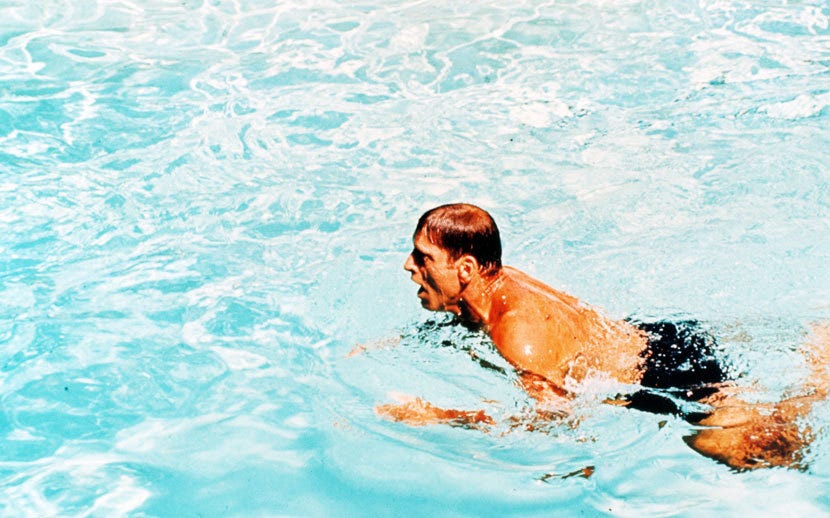
The Performer
Before he was Burt Lancaster, film star,
he was an acrobat.
That matters here.
The Swimmer is not just a film
about memory
status
and denial.
It is a film about a body moving through space.
Wet paving.
Garden walls.
Diving boards.
Ladders.
Lawns.
Changing weather.
Tired muscles.
Old confidence.
Fading elegance.
The body boasts.
The body persists.
The body tries to keep up with the legend.
And then there is the unfairness
of the whole thing.
Burt Lancaster was in his mid fifties
in The Swimmer
I mention this partly out of respect
and partly because he looked amazing.
Lean.
Tanned.
Athletic.
Entirely convincing
as a man who might decide
to cross half a county by water.
This has not improved
my relationship with exercise.
I really need to do some.
There is something else going on too.
Ned is not only travelling through pools.
He is travelling through perceptions.
Through other people’s versions of him.
Through his own fading image of himself.
The landscape changes
because the people change.
One garden offers hospitality.
Another discomfort.
Another pity.
Another contempt.
Another confusion.
Another quiet alarm.
So the route is not only physical.
It is social.
Emotional.
Mythological.
He is swimming through a broken reputation.
Which is one reason
the stepping-stone feeling matters.
Each place has its own tone
its own weather
its own truth.
One of the pleasures of London
is that it can feel like that too.
Not one city
but a chain of stations.
One stop
then another.
Green Park.
Piccadilly Circus.
Mile End.
A route made of names.
A line made of little worlds.
Swimming the Tube.
I like the idea of that.
Not literally, though in London
one should never rule out
some fresh sewage-based innovation
in public transport.
I mean as a structure.
A journey by stations.
A city understood
as a sequence of atmospheres.
The Swimmer already works like that.
He moves from pool to pool
as if changing lines.
He surfaces into different versions of America.
And perhaps that is why the film feels so close
to things I already love.
Ogham trees arranged in a wheel.
Tarot cards laid in sequence.
Tube maps.
Little systems of movement.
A route that becomes a reading.
The original story, of course,
was by John Cheever.
A short story first
then a film.
That matters too.
I like it when a thing changes form
and survives the crossing.
Story into film.
Film into memory.
Memory into some other object altogether.
The route through things
interests me almost as much
as the things themselves.
Which brings me, perhaps inevitably,
to Gustave Doré.
This is not a sensible route.
It does not matter.
Doré painted an acrobat family.
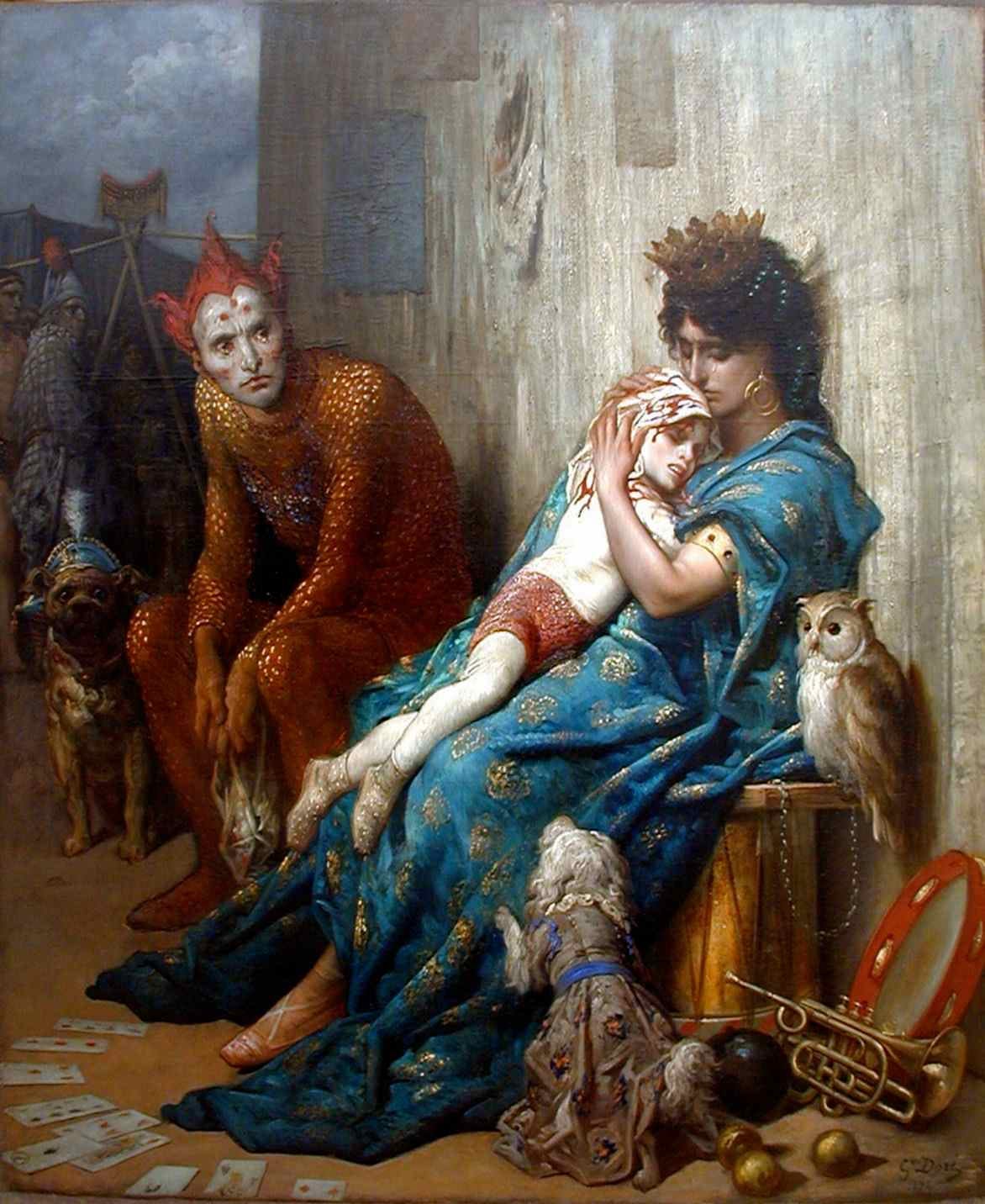
Three times, more or less.
A family of performers
gathered around an injured child.
Grief.
Theatre.
Bodies.
Spectacle.
The kind of image
that arrives already carrying
a whole story inside it.
Lancaster’s acrobat past
pulls Doré in behind it.
The acrobat never entirely leaves the swimmer.
Or perhaps the swimmer
never entirely leaves the acrobat.
There is a performer’s pride
in Ned Merrill.
A performer’s relationship to the body.
A sense that he can still carry the role
if he just keeps moving.
Still charm the audience.
Still make the risk look graceful.
Still turn strain into style.
The trouble is that the audience has changed.
And then there is Forest Grove.
A strange little web-based thing
from years ago.
It had its own site.
Or had had one.
By the time I went looking, it was already half gone.
I even contacted the creator on LinkedIn to ask if the original files still existed.
They didn’t.
So Forest Grove now lives for me in the same sort of state as many older things I seem to care about.
Part memory.
Part fragment.
Part reconstruction.
Images.
Voice-over.
A little boy made out of plastic models
moving through one of those big American housing communities.
Pool to pool.
Street to street.
A suburban dreamscape
or a suburban nightmare
built in miniature
and narrated in an eerily calm female American voice.
It is not The Swimmer.
But it rhymes with it in my head.
Strongly.
Enough that I can no longer think about one
without the other wandering in.
That may be the point
where this article gives away its real agenda.
Because as soon as plastic figures
and miniature housing estates
enter the picture
I stop being a film viewer
and start wanting to make things.
That is the danger.
One film leads to another image.
That image leads to a half-remembered website.
That website leads to a model estate.
That model estate leads to thoughts of
plastic
card
tiny paving slabs
little hedges
painted figures
resin water
suburban lamps
small windows lit from within.
One film
and suddenly I want the knives and glue out.
I want to make my own little worlds.
That may be what I really like
about The Swimmer.
Not simply the film itself,
though I do love it.
Not just Lancaster,
though I love him too.
Not just the odd private connection
of birthdays
decades
and favourite actors.
Not even 1968
that year surfacing again
like something lost but not entirely gone.
No, it is the route.
The way one thing leads to another.
The way the film behaves
like a map made of fragments.
Burt Lancaster.
Shah Rukh Khan.
Pools.
Tube stops.
Ogham stones.
Doré’s acrobats.
A little plastic boy
in an American estate.
A workbench waiting for attention.
I increasingly suspect
that memory is less like a filing cabinet
and more like a badly planned housing development
connected by swimming pools.
You think you are setting off for one house
and end up somewhere else entirely
wet through
carrying an acrobat
a Bollywood star
and a Tube map.
That seems about right.
Perhaps that is why The Swimmer lasts.
Not because it can be summarised
as a clever allegory about denial
class
and the collapse of masculine confidence,
though it can.
Not because it is a puzzle to be solved.
Not because it belongs neatly
to one decade
one reading
one meaning.
It lasts because it moves.
It moves through water.
Through gardens.
Through memory.
Through forms.
Short story to film.
Film to thought.
Thought to model.
Model to whatever comes next.
And somewhere in all that
a message arrives.
Make something.
Do some exercise first, perhaps.
Then make something.
Put some life into it.
Though today it’s just a bit
too hot.
Time for
a swim.